FIFA’s inaction in response to repeated warnings about racist US immigration policies and rhetoric has enabled the US authorities to subject multiple players and officials at the 2026 men’s World Cup to racial profiling, FairSquare said today. The US government has also used the tournament to promote racist propaganda.
“President Trump and the white nationalists steering his policies have used the World Cup to flaunt their racism and FIFA’s meek acquiescence amounts to complicity in this,” said FairSquare director Nick McGeehan, “FIFA was repeatedly warned about these risks, but instead of standing up against Trump’s racism, they let their players and officials be publicly humiliated in the service of the MAGA movement and gave the racist-in-chief a Peace Prize”
In the immediate run-up to the tournament FIFA failed to respond to a clear pattern of racial profiling of players and staff by the US authorities, most obviously in the case of Somali referee Omar Artan and players and staff from Iraq, Iran and Uzbekistan. The FIFA President, Gianni Infantino appeared to endorse the US authorities’ deportation of Artan, saying that “security goes above everything, and you need to respect the decisions which are taken.”
FIFA failed to respond to warnings about discriminatory immigration policies from 90 US civil society organisations nearly a year before the tournament began. It also failed to heed an intervention from the UN Committee on Racial Discrimination, which in March 2026 expressed grave concerns about what it called “the systematic use of racial profiling and arbitrary identity checks” against people of Hispanic/Latino, African or Asian origin, and warned that “racist hate speech by political leaders, including the [US] President” had the potential to “incite racial discrimination and hate crimes.” Donald Trump’s record of racist statements includes describing Somali people as “garbage”, saying that “illegal migration is poisoning the blood of our nation” and accusing Mexicans in the US of “bringing crime” and being “rapists.”
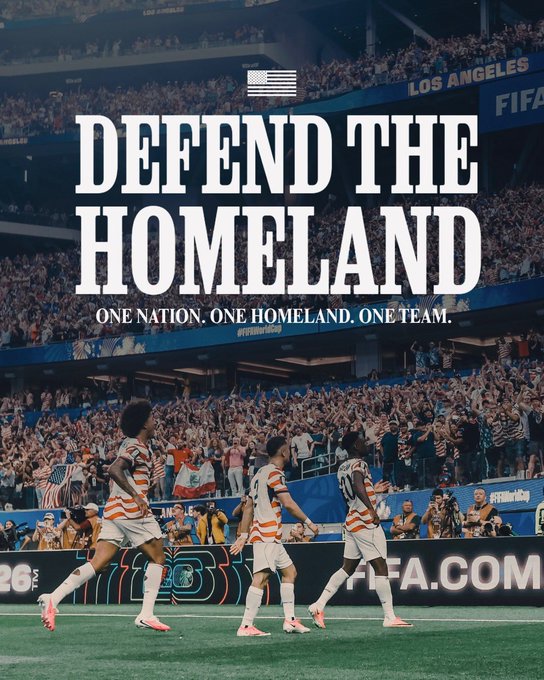
FIFA has made no comment on the US authorities’ use of the 2026 men’s World Cup to publish racist propaganda. On 19 June, the US Department of Homeland Security published a post on social media that combines imagery of the US men’s national team with language that “strongly flirts with Nazism”, according to an academic expert on far-right politics consulted by FairSquare. Whereas FIFA used previous World Cup tournaments to disseminate and promote anti-racism messaging, the US’s hosting of FIFA events has coincided with a dramatic reduction in this. FIFA removed almost all anti-racism messaging from the 2025 Club World Cup, hosted in the US, and only four of the scheduled 104 matches at the 2026 men’s World Cup will highlight FIFA’s anti-racism policies.
FIFA failure to challenge US authorities’ racial profiling
In a 2020 General Comment on the topic of racial profiling the UN Committee on the Elimination of Racial Discrimination (CERD) noted that various international and regional human rights bodies and institutions have adopted definitions of racial profiling, which have a number of common elements. Racial profiling is: (a) committed by law enforcement authorities; (b) is not motivated by objective criteria or reasonable justification; (c) is based on grounds of race, colour, descent, national or ethnic origin or their intersection with other relevant grounds, such as religion, sex or gender, sexual orientation and gender identity, disability and age, migration status, or work or other status; (d) is used in specific contexts, such as controlling immigration and combating criminal activity, terrorism or other activities that allegedly violate or may result in the violation of the law. CERD has noted that one effect of racial profiling is “a sense of injustice and humiliation”.
On 6 June, US immigration officers at Miami International Airport detained and questioned the Somali referee Omar Artan for 11 hours, and denied him entry to the country. The BBC and the New York Times reported that Artan said US officials asked him if he had links to the Somali militant group Al Shebab. Artan was one of 170 designated FIFA match officials for the tournament and in November 2025, the Confederation of African Football named him as the best male referee of 2025 at their annual awards ceremony. On 9 June, Andrew Giuliani, the head of the White House World Cup task force spoke at a public event and said that “there have been some officials that have been denied … we are striking that balance between making sure that bad actors that try to come into the country will not get access.” On Artan’s case specifically, he said “I can tell you … it was for very good reason that ultimately this referee didn’t get into the country.” In an interview with the Associated Press in October 2025, Giuliani described the men’s World Cup as the “MAGA-FIFA World Cup.” Donald Trump has a long, documented history of using xenophobic, Islamophobic, and racist rhetoric about Somalis. He has repeatedly targeted the first Somali member of Congress Ilhan Omar, including leading chants to “send her back”, as well as increasing ICE operations targeting Somali communities in Minnesota. In December 2025, Donald Trump described Somali people as “garbage” and said “I don’t want them in our country, I’ll be honest with you.”. The following week Trump described Somalia as “filthy, dirty, disgusting, ridden with crime. The only thing they’re good at is going after ships.” FIFA President Gianni Infantino responded to the US authorities’ refusal to admit Artan at a press conference in Mexico City on 10 June, four days after the incident. He said that the incident was “unfortunate”, but refrained from criticizing the decision and he did not defend Artan from thinly veiled allegations from senior US officials that he was a “bad actor”. On the contrary, Infantino appeared to endorse the US’s actions, saying that “our world is a very aggressive world and security goes above everything, and you need to respect the decisions which are taken.”
On 6 June, the Iranian authorities said that “FIFA must hold the US accountable for violations of its rules and for the discriminatory treatment of Iran’s national football team” after US authorities denied visas to 15 Iranian football officials, including the head of the football federation and his deputy. An unnamed US government official told The Athletic on 5 June that “We will not allow the Iranian team to abuse this system to sneak terrorists into the United States under false pretenses.” Andrew Giuliani said in an interview with TalkSport on that the Iranian football delegation that had applied for visas to enter the US had “direct ties to terrorists, that are having conversations with them…plotting about what they are going to do” The US authorities also prohibited the Iranian team from entering the US until 24 hours before their matches and required them to leave the country almost immediately after the completion of their games. On 29 June, US homeland security secretary, Markwayne Mullin expressed delight at Iran’s elimination from the tournament, saying “I was so happy when we were able to pull their visas and said they could leave the US soil, and I might’ve sung a song or two or maybe even danced a happy dance.” FIFA has not criticised the US’s decision to deny visas, restrict travel and has made no comment on US’s authorities’ unsubstantiated claim that members of the Iranian team’s delegation were terrorists.
On 6 June, a member of Iraq’s Olympic Committee told Reuters that US immigration officers at Chicago’s O’Hare airport Iraq’s held and questioned the Iraqi player Aymen Hussein for nearly seven hours at Chicago’s O’Hare airport, and denied entry to the Iraqi team’s photographer Talal Salah after 10 hours of questioning. The official also said US officials searched the contents of both men’s phones. FIFA has not commented on their treatment.
According to US and Uzbek media reports, metal detectors and sniffer dogs were deployed in searches of the luggage of the Uzbekistan national team upon their arrival at Icahn Stadium in New Jersey on 8 June, where they played a warm-up match against the Netherlands. Video on social media shows Uzbek players disembarking from a coach, apparently at the stadium, and being subjected to searches, with at least one sniffer dog visible. Uzbekistan manager Fabio Cannavaro indicated he believed his players and staff had been singled out, telling the media “They said to me it’s the rules, but in the end the check was only for us.” There is no indication that the Netherlands team was subjected to a similar security check. Uzbek media reported that the Uzbek Ministry of Foreign Affairs had contacted the US authorities “for clarification regarding the enhanced security screening.” FIFA has not commented on their treatment.
Video published online also shows US officials subjecting the Uruguay national team to a roadside search, which included sniffer dogs. The fact-checking and online anti-misinformation outlet Snopes reported that the video appears to show the Uruguayan national team arriving at Miami Stadium in Florida before their match with Saudi Arabia on 16 June, but said it remains unclear if it was a routine security check or if other teams went through the same checks. The Uruguayan football federation has made no comment on their treatment, nor has FIFA.
FairSquare was unable to discern if the Senegalese national team was subjected to racial profiling or simply to standard airport-security measures when they boarded a flight to San Antonio, where they played a warm-up friendly against Saudi Arabia on 9 June. The Senegalese football federation told Reuters that the searches, which took place on the tarmac rather than in terminal buildings, were carried out in compliance with “applicable airport security regulations” and were part of an arrangement to expedite travel. There is no evidence of sniffer dogs being involved, as some online reports claimed, and France 24 reported that artificial intelligence had been used to generate fake images of the Senegalese coach being searched. The Belgian team were subjected to similar security checks on the tarmac at an airport in Atlanta, for apparently similar reasons, in March 2026 ahead of a friendly match against the US.
FIFA failure to challenge US authorities’ racist propaganda
On 19 June, the US Department of Homeland Security (DHS) published a post on social media, which features three non-white players of the US men’s national team under the banner “Defend the Homeland. One nation. One homeland. One team.” The post is captioned with the words “Our soil” and the US flag. Professor Cas Mudde, an expert on far-right politics at the University of Georgia, told FairSquare that the post reflected “the dog whistle strategy of the Trump administration.” Professor Mudde noted the similarity between the DHS post and two famous Nazi slogans, “Ein Volk. Ein Reich. Ein Führer” (One Nation. One Empire. One Leader) and “Blut und Boden” (Blood and Soil), and said that the post “strongly flirts with Nazism, while at the same time keeping high deniability.” It has been viewed 6.8 million times on X. FIFA should have been aware of the possibility of the US authorities using the 2026 men’s World Cup to disseminate racist propaganda. In January 2026, The Atlantic published an article in which they described the official social-media channels of the Trump administration as having become “unrelenting streams of xenophobic and Nazi-coded messages and imagery”, and provided multiple examples of messages and imagery to substantiate their claim.
FIFA ignored multiple warnings about serious racial discrimination
In advance of the tournament FIFA was repeatedly warned about the US government’s advancement of racially discriminatory laws and policies.
In May 2025, Human Rights Watch wrote to FIFA with detailed concerns about U.S. immigration policies and requested information on the steps that FIFA was taking to ensure “that the U.S. government will permit players, fans and journalists from around the world to safely attend the 2026 World Cup”. FIFA’s response did not meaningfully address any of the issues raised in Human Rights Watch’s letter, stating simply that “if FIFA becomes aware of potentially adverse human rights impacts…we will engage with the relevant authorities.”
In July 2025, 90 US-based civil society organizations, including the ACLU and the NAACP, wrote to FIFA warning that “non-U.S. nationals traveling to or from the United States with prior authorization from the U.S. government are nevertheless at risk of arbitrary denial of entry, detention, and/or deportation” and called on FIFA to “publicly recognize the severity of the risks that U.S. government policies and practices pose to FIFA tournament attendees and migrant communities in the U.S. and publicly urge President Trump to reverse these policies and practices.” FIFA did not respond to the letter.
The pattern of racial profiling described above is consistent with concerns raised shortly before the start of the tournament by the UN Committee on the Elimination of Racial Discrimination (CERD). In March 2026, CERD published a five-page decision addressing the situation in the United States under its Early Warning and Urgent Action Procedure. Their intervention was prompted by a submission to the CERD by the ACLU in response to what it called “the human rights crisis in the Minneapolis and St. Paul metropolitan areas” of the United States whereby various law-enforcement bodies had been “targeting Somali and Latino individuals and those perceived to be Somali or Latino.” The CERD said it was “concerned about the reported increase in racial discrimination, including through racial profiling, and racist hate speech targeting migrants, refugees, asylum seekers and those perceived as such in the United States of America.” Dr David Keane, an academic expert on the CERD, told FairSquare that the mechanism was developed in the early 1990s in response to ethnic conflicts in the former Yugoslavia and Rwanda. “It is a very significant intervention – the CERD are clearly gravely concerned at the situation in the US,” said Dr Keane.
Reduction in FIFA’s anti-racist messaging
US hosting of FIFA tournaments has coincided with a significant reduction in FIFA’s dissemination of anti-racism messaging during tournaments. At the Women’s World Cup in 2023 in Australia and New Zealand and the Men’s World Cup in 2022 in Qatar, anti-discrimination messages were displayed in all stadiums and published across FIFA’s official social media. However, as reported by The Athletic, in June 2025 FIFA decided in advance of the Club World Cup in the United States not to show any videos, signage or marketing assets which explicitly mention challenging racism or discrimination in stadiums. One week into the 2026 World Cup FIFA claimed that it was “turning up the volume on its fight against discrimination” by having team captains exchange “special commemorative pennants” with anti-racism messaging, backed up by “striking, campaign-themed stadium LEDs”, but this has only happened in four of the matches that have taken place to date at the tournament, and FIFA has given no indication that the initiative will be repeated again before the conclusion of the tournament on 18 July.