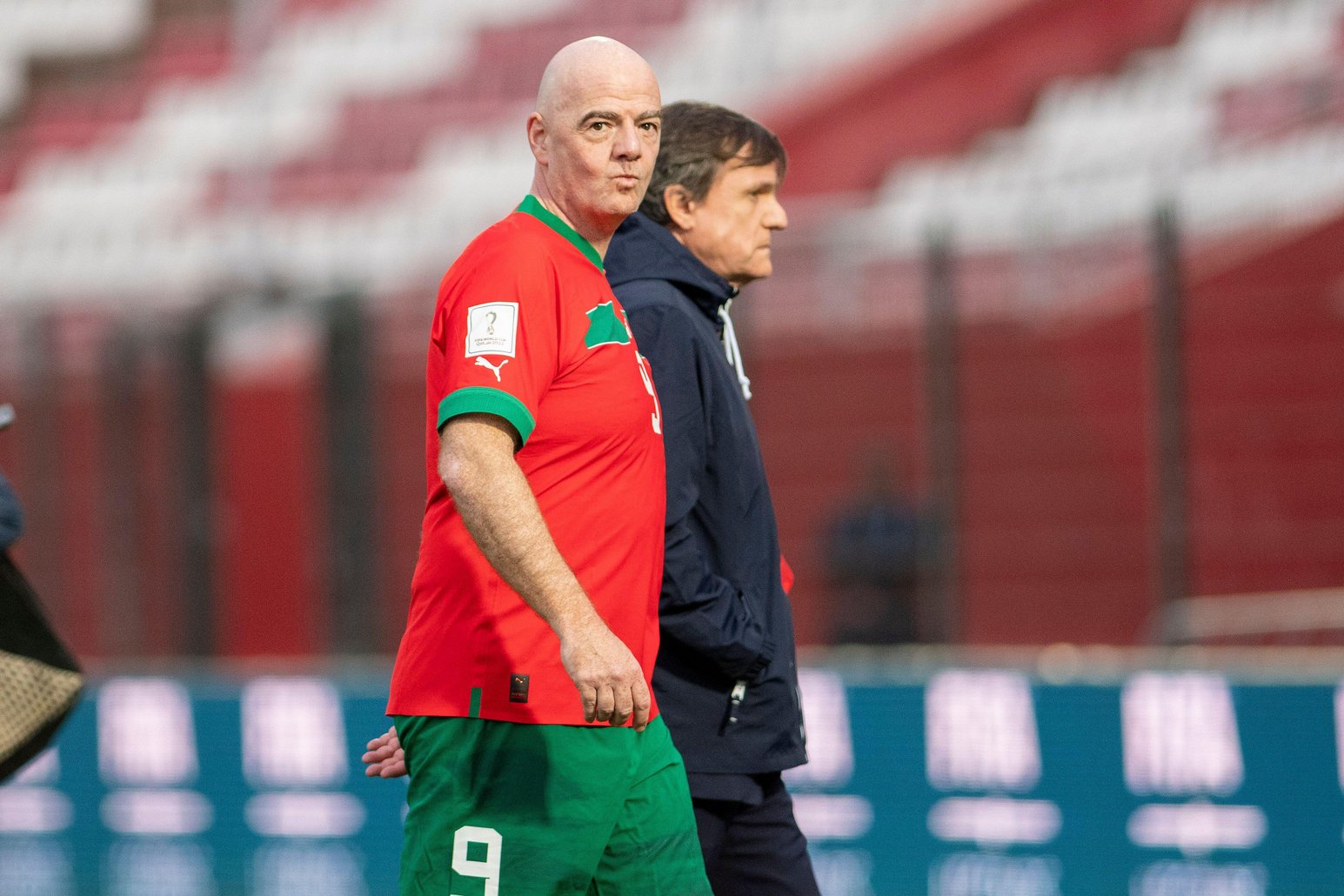
FairSquare has written to FIFA’s Governance, Audit and Compliance Committee and asked them to declare FIFA President Gianni Infantino ineligible to run for the FIFA Presidency in 2027. An apparent decision taken in December 2022 to discount Infantino’s first three-year term as counting as a presidential term clearly violates the letter and purpose of FIFA’s rules on term limits, and circumvented the authority of the FIFA Congress. FIFA has never published any reasoning to support the apparent decision, which has effectively introduced an unjustifiable and dangerous exception to a rule aimed at restraining executive power, and one that could have the effect of allowing FIFA Presidents to rule in perpetuity.
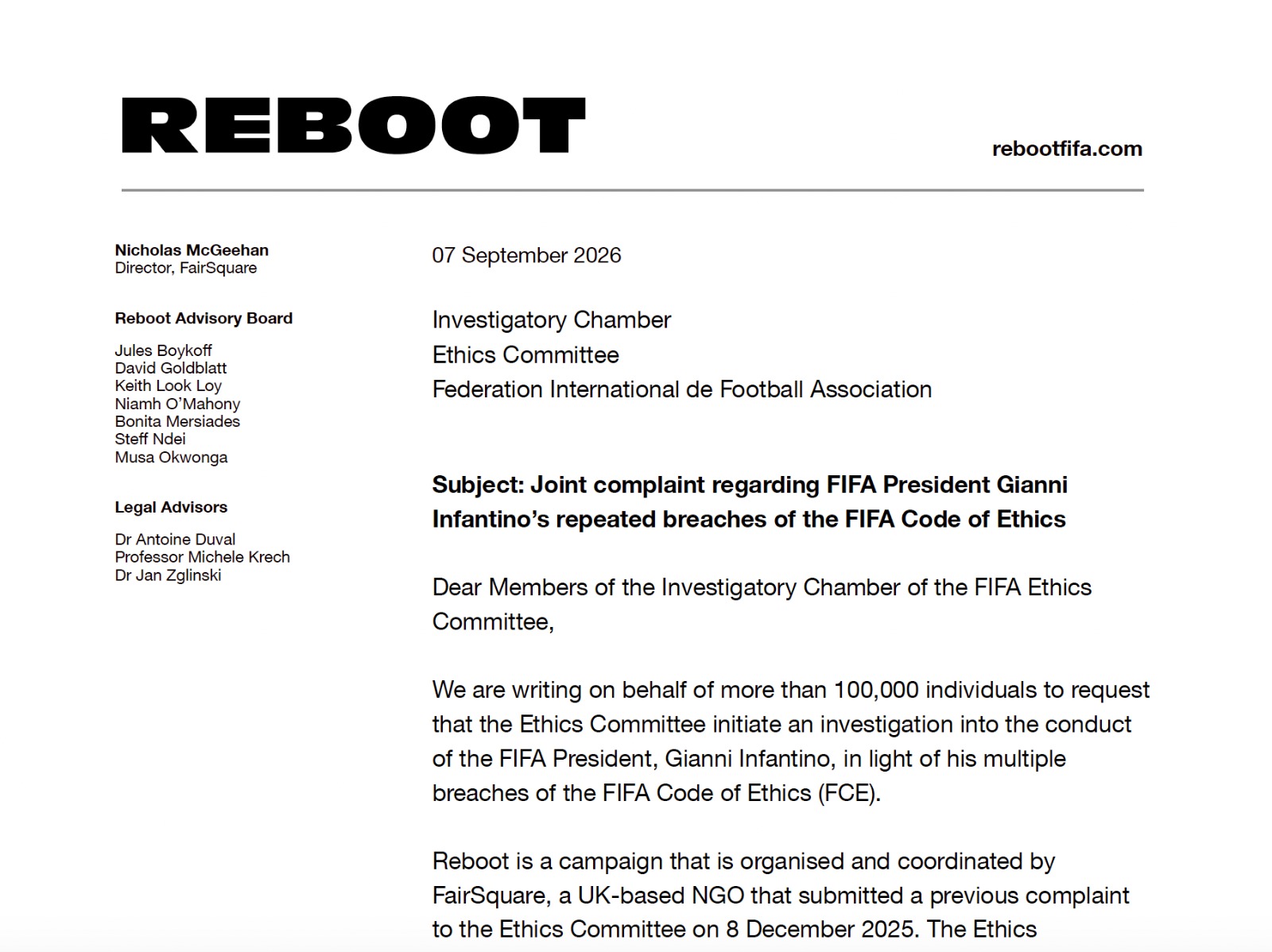
The letter is set in the context of FIFA’s biggest governance scandal since 2015, and calls from three regional confederations, including UEFA, for Gianni Infantino to resign as the FIFA president for what they call “a profound failure of judgment”, in attempting to sell off a stake in FIFA’s tournaments to a consortium of private equity. The letter was drafted with the assistance of Professor Miguel Maduro, a former head of the FIFA Governance Committee who, along with several colleagues, left FIFA in 2017 after FIFA’s senior leadership interfered with their efforts to enforce rules on a wide range of critical governance issues, including political neutrality. It was addressed to Bruno Chiomento, Professor Chris Mihm, and Molly Rhone, the three members of the Review sub-committee of the Governance, Audit and Compliance Committee that has a statutory mandate to rule on the eligibility of candidates for the FIFA Presidency.
“Gianni Infantino is unfit to be the FIFA President, but the process by which he leaves is critically important. If Infantino is deposed by power dynamics rather than because he has broken the rules, it will reinforce the power of the political cartel that runs the game and gave us Infantino. Those who care about the game and are serious about FIFA reform must be clear about the rules Infantino has broken and ask why he has been able to abuse presidential powers to this extent.” Nick McGeehan, director, FairSquare.
“The principle of term limits was a fundamental aspect of the 2016 reform aimed at limiting power and the rule introduced is clear: no FIFA President can serve more than three terms of office. Mr Infantino cannot be a candidate to a fourth term of office. Trying to carve out an exception to such a rule for Mr Infantino reveals both a resistance to the principle of term limits and how some at FIFA conceive of rules not as rules but as obstacles to be circumvented. Those that oppose Mr Infantino have an opportunity to show that they are interested in more than simply toppling Mr Infantino and are committed to the rule of law and the principle of term limits at FIFA.” Professor Miguel Maduro, Dean of Católica Global School of Law.
Gianni Infantino was elected FIFA President at an Extraordinary FIFA Congress in February 2016. The FIFA Congress has since re-elected him twice, in June 2019 and in March 2023. Article 33(2) of the FIFA Statutes outlines the rule on presidential term limits:
“The President shall be elected by the Congress for a period of four years in the year following a FIFA World Cup™. The term of office shall begin after the end of the Congress at which the President was elected. No person may serve as President for more than three terms of office (whether consecutive or not).”
According to the letter of the law, this presidential term constitutes Mr Infantino’s third and final term in office, however at the 2026 FIFA Congress in Vancouver, Mr Infantino announced his intention to run for President in 2027. This was enabled on the basis of an apparent decision or opinion issued by the Governance, Audit and Compliance Committee in 2022. On 16 December 2022, the FIFA Council held a meeting in Doha, Qatar, after which FIFA published a press release which referred to this decision:
“The FIFA Council also unanimously confirmed its agreement with the view of the Governance, Audit & Compliance Committee that the period between 2016 and 2019 does not count as a term of office for the current FIFA President, who is therefore about to end his first term.”
FIFA has never published any reasoning to support this apparent decision. The statutes explicitly state that “no person may serve as President for more than three terms of office” without making any distinction as to those terms of office. The letter of the rule is clear and does not provide for any exception based on the complete or incomplete nature of the term of office, or with respect to the type of Congress – Ordinary or Extraordinary – at which the election took place. The interpretation being relied on will allow Mr Infantino to serve 15 years – only two years less than his predecessor, Sepp Blatter, who resigned after the corruption scandal that prompted the 2016 Reform Committee to recommend strict presidential term limits. This was clearly not the purpose of the introduction of article 33(2) in the FIFA Statutes in 2016, indeed an interpretation that only four year terms count would, de facto, render the rule on term limits ineffective. An incumbent President could use his position within the FIFA Council, which has the power to call presidential elections, before the end of a full term to remain in power indefinitely. In view of Mr Infantino’s various abuses of power and the failure of the FIFA Council to hold him to account, such a scenario is plausible.
In addition to the misinterpretation of the rule’s letter and purpose, FIFA has not explained why the FIFA Council appeared to approve it, nor why the FIFA Congress, which is the only body that is competent to amend the limit of three terms of office, was circumvented.
FairSquare has filed complaints against Gianni Infantino with both the FIFA Ethics Committee and the International Olympic Committee for the FIFA President’s repeated violations of their respective rules on political neutrality.